SBTi vừa bước sang một cột mốc lớn: Corporate Net-Zero Standard phiên bản 2.0 được công bố ngày 11/6/2026. Đây là bản nâng cấp lớn nhất kể từ 2021, định hình lại cách doanh nghiệp đặt và thực thi mục tiêu Net-Zero. Bài viết này phân tích các thay đổi cốt lõi, trọng tâm về kiểm kê Scope 3, lộ trình chuyển đổi và cách chuẩn bị.
Bối cảnh: vì sao SBTi ngày càng quan trọng với doanh nghiệp Việt Nam?
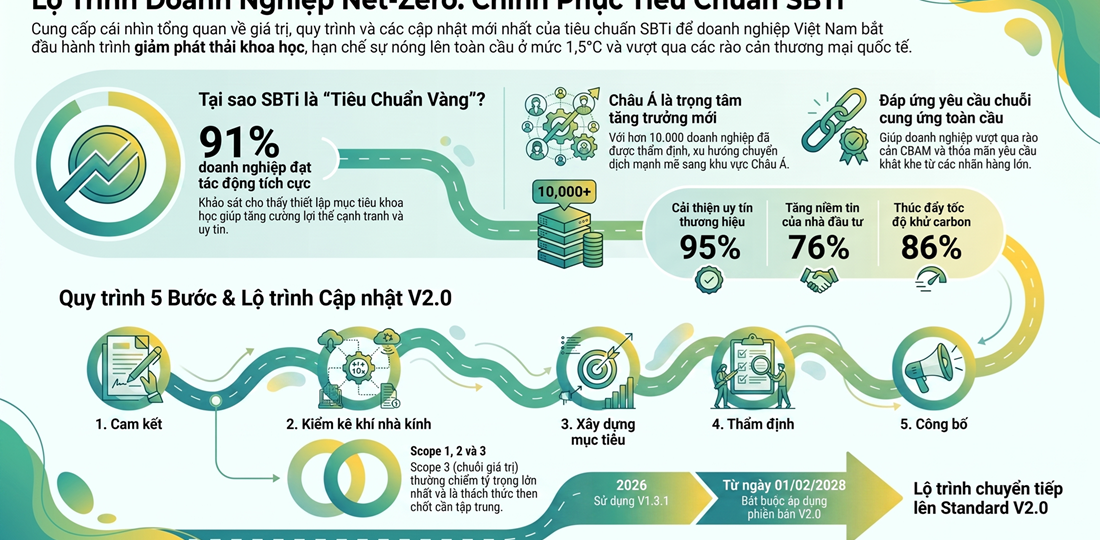
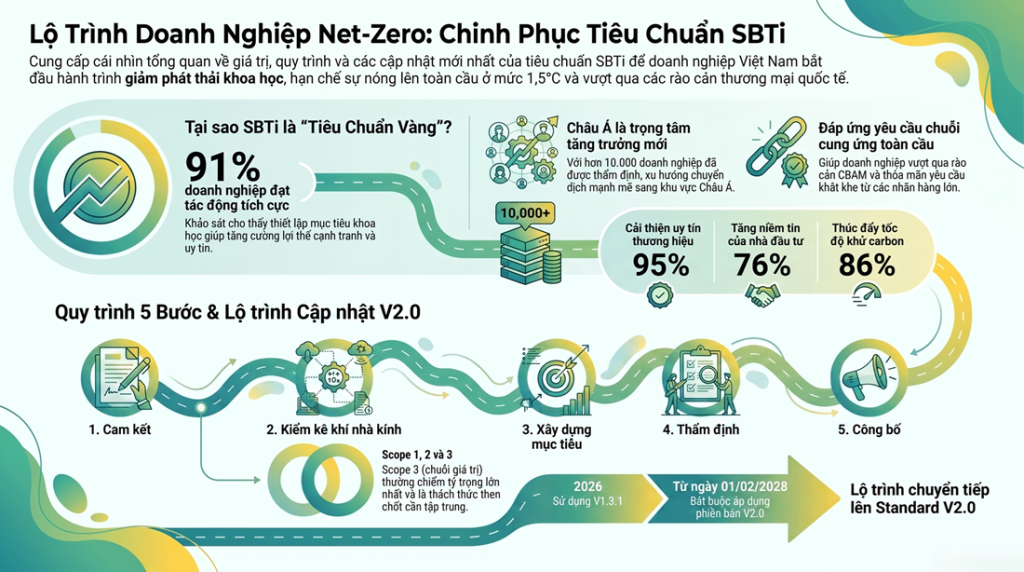
Theo SBTi, tính đến tháng 1/2026 đã có hơn 10.000 doanh nghiệp có mục tiêu được thẩm định, ~13.000 nếu tính cả cam kết; tăng trưởng +40% trong năm 2025, với châu Á nổi lên là trung tâm. Với doanh nghiệp Việt Nam trong chuỗi cung ứng toàn cầu, mục tiêu khoa học đang dần trở thành yêu cầu từ khách hàng và nhà đầu tư, chứ không còn là lựa chọn.
Corporate Net-Zero Standard V2.0: những thay đổi cốt lõi
V2.0 là khuôn khổ toàn diện nhất của SBTi tới nay, với các điểm nhấn:
| Lĩnh vực | Nội dung chính |
|---|---|
| Phân nhóm doanh nghiệp | Chia thành Category A (doanh nghiệp lớn/mid-market) và Category B (đa số SME), với nghĩa vụ tương xứng |
| Hỗ trợ khác biệt theo bối cảnh | Ưu đãi riêng cho SME và doanh nghiệp ở quốc gia thu nhập thấp |
| Mục tiêu theo bối cảnh | Mục tiêu được thiết kế theo ngành, khu vực địa lý và “legacy capital stock” |
| Phản ánh đòn bẩy của doanh nghiệp | Mục tiêu gắn với các hành động doanh nghiệp thực sự có thể làm |
| Tập trung vào thực thi | Chuyển trọng tâm từ “tham vọng” sang “triển khai thực tế”, minh bạch tiến độ |
Scope 3: trái tim và thách thức lớn nhất
Với hầu hết doanh nghiệp, Scope 3 (phát thải gián tiếp trong chuỗi giá trị) chiếm phần lớn tổng phát thải – từ nguyên liệu đầu vào, vận chuyển, đến sử dụng và thải bỏ sản phẩm. Đây cũng là phần khó kiểm kê nhất vì phụ thuộc dữ liệu từ nhà cung cấp và đối tác.
Điểm quan trọng: dữ liệu hoàn hảo không phải điều kiện tiên quyết để bắt đầu. Doanh nghiệp nên khởi động kiểm kê Scope 3 với dữ liệu sẵn có, cải thiện dần theo thời gian. Lưu ý: với V2.0, mục tiêu Scope 3 vẫn tùy chọn cho SME (Category B) – nhưng nếu bạn cung cấp cho doanh nghiệp lớn, dữ liệu phát thải của bạn trở thành một phần trong tuân thủ của họ (chuẩn bị cho việc nhận nhiều “bảng câu hỏi nhà cung cấp” hơn).
Lộ trình chuyển đổi: doanh nghiệp cần làm gì ngay?
- Trong 2026: V1.3.1 là khung áp dụng để thẩm định.
- Nộp mới theo V1.3.1: đến 31/12/2027.
- Từ đầu 2027: có thể nộp theo V1.3.1 hoặc V2.0 (chuyển tiếp).
- Từ 1/1/2028: V2.0 bắt buộc cho mục tiêu mới.
Lời khuyên: Nếu đặt mục tiêu trong 2026, hãy làm ngay theo V1.3.1 và xây nền dữ liệu vững để chuyển sang V2.0 thuận lợi. Bắt đầu sớm luôn có lợi.
Vì sao đào tạo & tư vấn là yếu tố quyết định?
SBTi đòi hỏi kiến thức chuyên sâu về kiểm kê khí nhà kính, phương pháp đặt mục tiêu và quy trình thẩm định. Đào tạo và tư vấn giúp:
- Đội ngũ hiểu đúng GHG Protocol và cách kiểm kê Scope 1/2/3.
- Xây mục tiêu đúng phương pháp, tránh bị từ chối khi thẩm định.
- Chuẩn bị sẵn sàng cho yêu cầu của V2.0 và các quy định công bố ESG.
Dịch vụ đào tạo & tư vấn SBTi
Chúng tôi là đơn vị tư vấn – đào tạo độc lập, đồng hành cùng doanh nghiệp (việc thẩm định mục tiêu do SBTi thực hiện):
- Đào tạo về SBTi, kiểm kê khí nhà kính (GHG Protocol) và phương pháp đặt mục tiêu khoa học.
- Tư vấn kiểm kê Scope 1/2/3 và thu thập dữ liệu chuỗi giá trị.
- Hỗ trợ xây dựng mục tiêu theo V1.3.1 và chuẩn bị nền tảng cho V2.0.
- Hỗ trợ chuẩn bị hồ sơ nộp thẩm định đến khi mục tiêu được phê duyệt.
Câu hỏi thường gặp (FAQ)
1. V2.0 khác gì lớn nhất so với bản cũ? Phân nhóm Category A/B với nghĩa vụ tương xứng, hỗ trợ khác biệt cho SME và quốc gia thu nhập thấp, và trọng tâm chuyển sang thực thi.
2. Khi nào V2.0 bắt buộc? Từ 1/1/2028 cho mục tiêu mới; V1.3.1 vẫn nhận nộp mới đến 31/12/2027.
3. Doanh nghiệp tôi là SME, có cần làm Scope 3 không? Với V2.0, Scope 3 thường là tùy chọn cho SME – nhưng nếu bạn cung cấp cho doanh nghiệp lớn, dữ liệu của bạn vẫn quan trọng với họ.
4. Chưa có dữ liệu Scope 3 đầy đủ thì có bắt đầu được không? Được. Dữ liệu hoàn hảo không phải điều kiện tiên quyết; nên bắt đầu với dữ liệu sẵn có và cải thiện dần.
Liên hệ để được tư vấn doanh nghiệp
STC VN Co., Ltd. (Staunchly Vietnam) Hotline: +84 933 096 426 – +84 868 591 260 Email: info@staunchlyservices.com.vn Website: staunchlyservices.com.vn
Đối tác: ISC Global Co., Ltd. Hotline: +84 933 096 426 – +84 868 591 260 Email: info@iscglobal.asia | van.pham@iscglobal.asia Website: iscglobal.asia | iscglobal.edu.vn
Đại diện tại Việt Nam – Duc Luong Services Hotline: +84 933 096 426 – +84 868 591 260 Email: ducluongservices@gmail.com Website: ducluongservices.com
SBTi Certification & Net-Zero Consulting in Vietnam: Setting Science-Based Targets the Right Way (2026 Guide)
For manufacturers and exporters operating in Vietnam, climate targets are no longer optional. Global brands, FDI buyers, and tightening regulations such as the EU’s CBAM and CSRD now require suppliers to prove their decarbonization is credible and measurable. The Science Based Targets initiative (SBTi) has become the global “gold standard” for doing exactly that — and SBTi consulting in Vietnam is now a strategic necessity, not a nice-to-have.
Staunchly Vietnam (STC VN Co., Ltd.), together with ISC Global, helps companies across Vietnam set, validate, and communicate science-based targets — fully aligned with the brand-new Corporate Net-Zero Standard Version 2.0, released by the SBTi on 11 June 2026.
What is the SBTi?
The Science Based Targets initiative (SBTi) is a global climate-action organization that enables companies and financial institutions to set greenhouse gas (GHG) reduction targets aligned with the central goal of the Paris Agreement: limiting global warming to 1.5°C above pre-industrial levels.
Founded in 2015 as a collaboration between CDP, the UN Global Compact, the World Resources Institute (WRI), and WWF (with the We Mean Business Coalition), the SBTi was incorporated as a UK charity in 2023. Independent validation is carried out by its dedicated subsidiary, SBTi Services.
A target is considered “science-based” when it specifies how much and how fast a company must cut emissions to help avoid the worst impacts of climate change — based on the latest climate science rather than convenience.
Why SBTi matters for companies in Vietnam
By early 2026, more than 10,000 companies worldwide had SBTi-validated targets, with over 11,000 having committed or set targets. Target-setting grew roughly 40% in 2025, and Asia is emerging as a centre of gravity — a direct signal for Vietnamese businesses.
Key benefits include:
- Meeting supply-chain and trade requirements (CBAM, CSRD, brand mandates).
- Strengthening competitiveness within FDI and global value chains.
- Improving access to green finance through credible, validated targets.
- Managing transition risk ahead of tightening carbon policy.
According to the SBTi, 91% of surveyed companies reported that science-based targets had an overall positive impact on reputation, strategy, and long-term financial performance.
The main types of SBTi targets
Targets map to the three GHG Protocol scopes: Scope 1 (direct), Scope 2 (purchased energy), and Scope 3 (value chain).
- Near-term targets (mandatory): a 5–10 year horizon covering at least 95% of Scope 1 and 2 emissions. If Scope 3 exceeds 40% of total emissions, a Scope 3 target covering at least 67% is required.
- Net-zero targets: reduce emissions by at least 90% across the value chain by 2050 at the latest; the long-term target must cover at least 95% of Scope 1 and 2 and 90% of Scope 3.
- Neutralization: any residual emissions that cannot be cut must be counterbalanced with permanent carbon removal and storage before a net-zero claim can be made.
Approved methods include the Absolute Contraction Approach (ACA) — updated by the SBTi on 29 April 2026 — and the Sectoral Decarbonization Approach (SDA) for high-emitting sectors.
The four-step SBTi process
- Commit — register on the SBTi portal; companies have 24 months from commitment to submit targets (this step can be skipped).
- Develop — build the Scope 1, 2 & 3 GHG inventory, choose a base year and target boundaries, and calculate targets aligned with a 1.5°C pathway.
- Submit & Validate — SBTi Services reviews and validates targets (typically ~30 business days for near-term and ~60 for net-zero).
- Communicate & Disclose — announce approved targets and report progress annually.
Important update: Corporate Net-Zero Standard V2.0
On 11 June 2026, the SBTi published Corporate Net-Zero Standard Version 2.0 — its most comprehensive framework to date, marking a shift from ambition to real-world implementation. Companies in Vietnam should note:
- Transition timeline. Throughout 2026, Version 1.3.1 remains the applicable framework for validation. From Q1 2027, companies may submit under V1.3.1 or V2.0. From 1 February 2028, all new submissions must use V2.0.
- Differentiated approaches. V2.0 adds accommodations for small and medium-sized enterprises (SMEs) and companies in lower-income countries — improving accessibility.
- Continuous improvement. Annual reporting and periodic assessment of progress and barriers are now embedded.
- High-integrity carbon credits. V2.0 treats carbon credits and climate contributions as a complement, not a substitute for actual emissions reductions.
Practical tip: If your company is setting targets in 2026, start now using the established V1.3.1 — you can still benefit from many V2.0 innovations without waiting.
Our SBTi consulting & validation support services
Staunchly Vietnam and ISC Global provide end-to-end support:
- Readiness assessment & strategy — evaluate data maturity and choose the optimal target pathway.
- GHG inventory — quantify Scope 1, 2 & 3 emissions under the GHG Protocol and ISO 14064; support third-party verification.
- Target development — apply ACA or SDA and ensure coverage thresholds are met.
- Submission & validation support — prepare evidence, respond to reviewer queries, and shepherd targets to approval.
- Communication & reporting — craft SBTi-aligned messaging that avoids greenwashing and set up annual progress reporting.
Frequently asked questions (FAQ)
Is SBTi a certification? Not exactly — it is a target validation performed by SBTi Services, confirming your targets meet rigorous science-based criteria. It is the credible basis for any net-zero communication.
Can SMEs participate? Yes. The SBTi offers a streamlined route for SMEs, and V2.0 expands accommodations further.
How long does it take? It depends on data readiness; companies have up to 24 months from commitment to submit. A solid GHG inventory is the key accelerator.
Talk to our SBTi experts
Whether you are an exporter facing CBAM, an FDI supplier under brand requirements, or a company building its long-term net-zero roadmap, our team can help you set credible, validated targets.
Contact us for a business consultation:
📞 Hotline: +84 933 096 426 – +84 868 591 260 📧 Email: info@staunchlyservices.com.vn 🌐 Website: staunchlyservices.com.vn
ISC Global 📞 Hotline: +84 933 096 426 – +84 868 591 260 📧 Email: info@iscglobal.asia | van.pham@iscglobal.asia 🌐 Website: iscglobal.asia | iscglobal.edu.vn
Vietnam representative partner – Duc Luong Services 📞 Hotline: +84 933 096 426 – +84 868 591 260 📧 Email: ducluongservices@gmail.com 🌐 Website: ducluongservices.com